
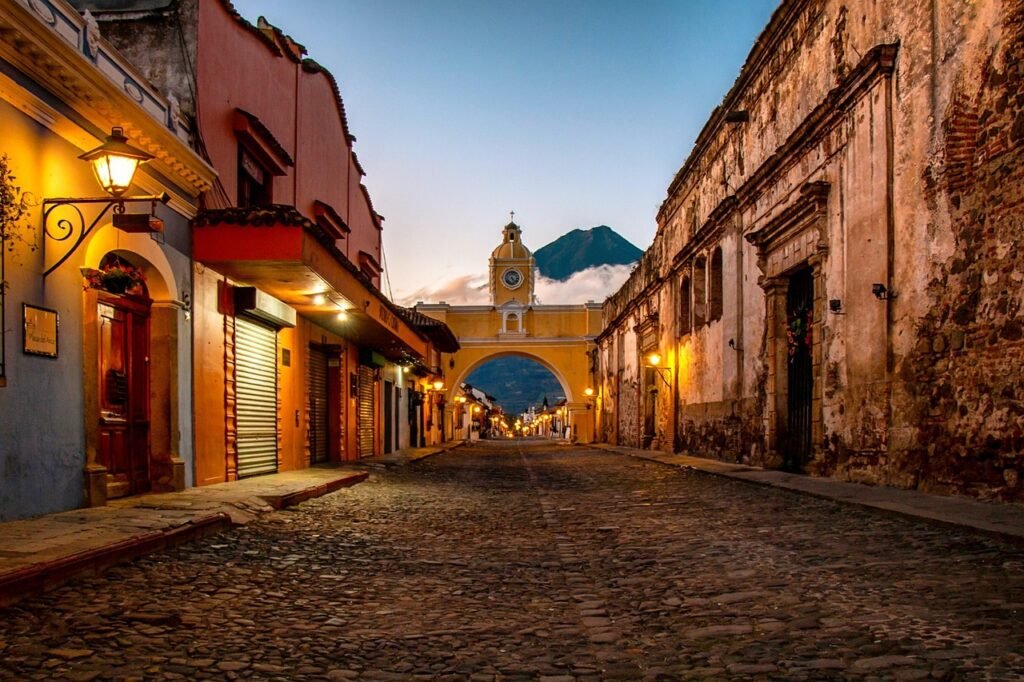
Antigua
Guatemala is a country located in Central America, famous for having been the seat of the Spanish kingdom in the region. The country has a unique culture and natural landscapes that you won’t find anywhere else in the world.
The cradle of the Mayan civilization, Guatemala is home to impressive archaeological ruins, such as those of Tikal, and charming colonial cities like Antigua.
The country offers a unique combination of adventure and tranquility, with friendly and welcoming inhabitants who treat visitors very well.
Guatemala blends natural beauty with authentic cultural experiences, ideal for those seeking a destination that provides unforgettable experiences.
Prepare to expand your perspective on the world with everything Guatemala has to offer.
Antigua in Guatemala is a city founded in the 16th century, was the former capital of Guatemala, and is now recognized as a UNESCO World Heritage Site.
Its cobblestone streets, colorful buildings, and ruins preserved even after an earthquake make the city an open-air museum.
Furthermore, Antigua is surrounded by three majestic volcanoes – Agua, Fuego, and Acatenango – which create a landscape that will make you want to take many, many photos.
If you’re looking for a destination that will broaden your cultural horizons and transform your worldview, Antigua is the place to be.
This historically and culturally rich city in Central America offers an immersive experience in its fascinating colonial history, which both captivates and educates.
The beauty of Antigua also lies in its contrasts: despite being a region with economic limitations, the city offers an authentic experience and reflects a reality different from what we are used to.
This contrast leads us to reflect on luxury and simplicity, highlighting the complex particularities of each country.
The Spanish arrived in this region and founded the city in 1542 or 1543, making it one of the oldest in the Americas.
Its initial name was Santiago de los Caballeros de Guatemala.
It is located practically in the center of Guatemala at an altitude of 1,545 meters, strategically built to be the capital of the Kingdom of Spain in Central America.
Antigua was declared a UNESCO World Heritage Site in 1979, thanks to its preserved colonial architecture and historical significance.
Its buildings are low and colorful, creating a historical atmosphere that makes you feel transported to that time.
In the 18th century, Antigua suffered three strong earthquakes, the strongest of which, in 1773, destroyed the city, which was practically abandoned, and the city of Nueva Guatemala de la Asunción was built.
Currently, it is the country’s capital, Guatemala City.
Over the years, Antigua was rebuilt, but the churches and convents remained in ruins and today contribute to the city’s charm.
Santa Catalina Arch
The most famous postcard view of Antigua, so it’s almost a mandatory stop for photos.
It dates back to the 17th century and offers an incredible view of the Agua Volcano in the background.
This arch was a bridge connecting a convent, where the nuns could pass unseen by the population.
Back then, things like that happened, maybe they still do somewhere in the world today.
Central Park
The heart of Antigua, Parque Central is the meeting point for locals and tourists.
Interestingly, Antigua’s main square isn’t called Plaza Mayor, as is the case in practically all cities founded by the Spanish.
Surrounded by colonial buildings and beautiful structures, such as the Cathedral of San José, it’s a great place to observe the movement and behavior of life in Antigua.
Take the opportunity to sit in one of the many cafes and enjoy a traditional Guatemalan coffee.
Ruins of Churches and Convents
The city has several ruins of churches and convents that were partially destroyed by earthquakes over the centuries.
Among the most impressive are the ruins of La Recolección, the Convent of Las Capuchinas, and the Church of San Francisco.
But as you walk through the city you will find various ruins that will catch your attention or not, depending on each structure.
Cerro de La Cruz
Cerro de la Cruz is one of Antigua’s most famous viewpoints, offering spectacular panoramic views of the city and the imposing Agua volcano in the background.
Depending on the weather, you might even be able to spot the other two volcanoes: Acatenango and Fuego.
The stone cross, which gives the place its name, makes the scenery even more iconic for photos.
National Museum of Art of Guatemala (MUNAG)
The National Art Museum of Guatemala, or MUNAG, is a space dedicated to the preservation and exhibition of the country’s rich artistic heritage, which spans more than 3,000 years.
Located in the restored Royal Palace of the Captains General, it is situated in Central Park.
The museum displays an impressive collection ranging from pre-Hispanic art to contemporary works, including sculptures, paintings, and historical objects.
In addition to hosting permanent and temporary exhibitions, MUNAG offers an educational and cultural experience that connects visitors with Guatemalan history and creativity.
Pacaya Volcano
This volcano is about a 1 hour and 30 minute bus ride from Antigua, plus another 1 hour of moderate to strenuous hiking to reach the viewpoint that offers a close-up view of the volcano.
On lucky days, you may be able to see the other volcanoes from the viewpoints along the trail.
Acatenango Volcano
If you’re looking for a life-changing adventure, visiting the Acatenango volcano is an option for you.
Because you might be lucky enough to see a volcano erupting.
You’ll take a two-day tour and spend the night at the summit with a sunrise view that those who go say is unforgettable.
Coffee Plantations and Villages Around Antigua in Guatemala
A Guatemala é famosa pelo seu café de alta qualidade, e há várias plantações nas proximidades de Antigua que oferecem tours guiados.
Chamadas de Fincas, você pode contratar um passeio para conhecer mais sobre os cafés do país.
Onde você vai aprender sobre o processo do café.
Se quiser você também pode explorar vilarejos próximos, como San Juan del Obispo e Ciudad Vieja, que têm suas próprias atrações e modo de viver.