
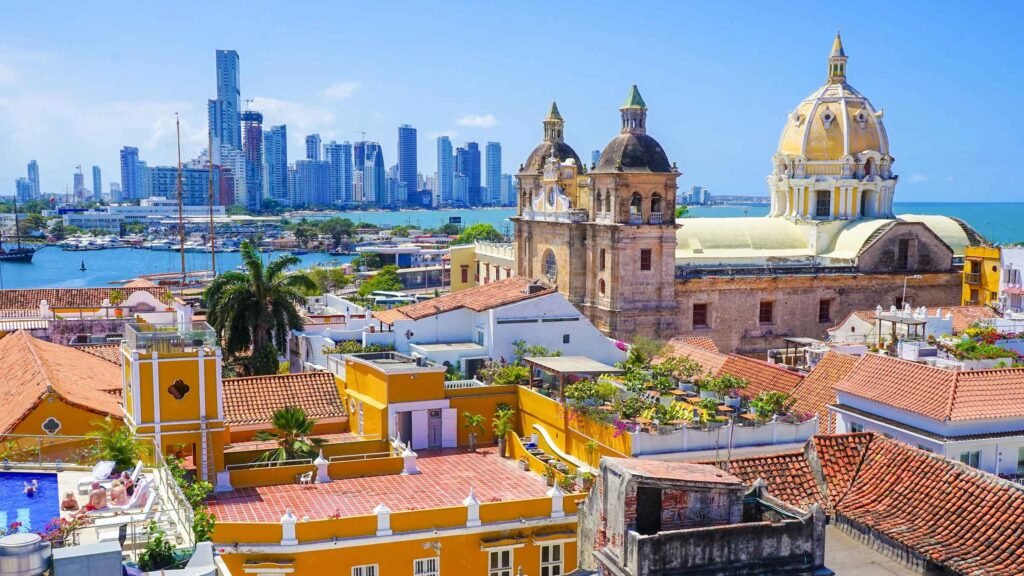
Colombia is one of the coolest destinations in South America, combining history, culture, and breathtaking landscapes.
With its colonial charm, Caribbean beaches, and the exuberance of the Amazon Rainforest, the country surprises by offering so much diversity in one place.
Whether exploring historic cities, relaxing by the sea, or discovering nature, Colombia offers travelers seeking authentic and unforgettable experiences.
Main cities to visit
Cartagena: A magical destination with colonial walls, colorful streets, and nearby beaches.
Bogotá: The capital is a mix of modernity and history, with the Candelaria neighborhood and incredible museums.
Medellín: The city of eternal spring is vibrant and full of culture and innovation.
Cali: The birthplace of salsa, perfect for those who want to dance and explore the local culture.
Santa Marta: The gateway to Tayrona National Park and paradisiacal beaches.
Cartagena
Cartagena de Indias, in Colombia, is much more than a tourist destination: it’s about discovering a colonial past, marked by almost 400 years of Spanish rule.
Take your time strolling through the narrow, charming streets, and you’ll feel history unfolding before your eyes in the colorful houses, the narrow alleyways, and the scattered art you’ll find.
And each corner reveals a different Cartagena with:
Museums that tell the colonial history of the city.
Imposing churches full of detail.
Historic squares, ideal for pausing, observing the activity, and reflecting on what that place was like 200 years ago.
Bars and restaurants for all tastes, from cozy cafes to haute cuisine.
If you want to learn even more about the history and essence of Cartagena de Indias, you can’t miss a visit to Getsemaní!
This historic neighborhood was the first home of freed slaves, as they were not allowed to live within the walled city.
Today, Getsemaní has transformed into one of the coolest and most culturally rich areas of the city.
Walking through its streets, you will find:
Colorful graffiti that tells local stories and reflects the neighborhood’s identity.
Trendy hostels, popular with a younger crowd.
Lively nightclubs, such as the famous Café Havana and Quiebra Canto, which attract tourists with plenty of salsa and reggaeton.
The Castle of San Felipe de Barajas is one of the largest fortifications built by the Spanish in South America.
It took over 100 years (1536–1657) to complete and underwent several expansions as Cartagena gained more importance for the Spanish Crown.
Cartagena was one of the most important ports in the colony, through which gold and other precious items extracted from Gran Colombia passed on their way to Spain.
This wealth attracted constant pirate attacks, and the castle was strategically built to protect the city from invasions both by sea and by land.
The Santa Cruz de La Popa Convent is one of Cartagena’s most emblematic landmarks, both for its history and its views of the city and the Caribbean Sea.
Built in the 17th century, the convent is located at the highest point in the city, offering a virtually unique experience for tourists.
The convent was founded by Augustinian friars in 1607 and was named “La Popa” because its shape resembles the stern of a ship.
For centuries, it was an important religious site and also played a strategic role in the city’s defense, serving as an observation point.
This was because the Church and the Spanish Empire worked together to expand their dominion in America.
Bogotá
Bogotá is located almost in the middle of Colombia, much closer to Central America than to Brazil.
Cerro de Monserrate
There are two ways to reach Cerro de Monserrate. One, mentioned above, is by funicular, and the other is by hiking a trail that takes about 2 hours to reach the top.
Once there, you’ll see the city of Bogotá and other points of interest; there’s a path that tells the story of the Stations of the Cross.
In addition, there’s a restaurant run by a very famous chef that you can enjoy.
Basilica of the Lord of Montserrat
Another point of interest on Cerro de Monserrate is the Basilica located at the top of the hill; it’s very beautiful and full of details to observe.
Next to the Basilica there’s a small market with souvenirs and typical local foods.
La Candelaria neighborhood
This is the traditional neighborhood of Bogotá, its historical center, as the city began there. It’s worth exploring on foot, as there are details that can only be appreciated by walking.
Here you’ll find many great places to visit, such as Simon Bolívar Square, the Colombian Parliament, the Cathedral of Colombia, the Palace of Justice, the Police Museum, and much more. I’ll detail more information about each place below.
National Museum of Colombia
A museum with over 20,000 artifacts dating back to the 16th century. There’s a lot to see in the museum; if you’re not very keen on this type of outing, go inside and see some of the exhibits and head to Café Juan Valdez, located in the museum’s garden.
Colombian Mint
The Mint is also located in the La Candelaria neighborhood, right next to the Botero Museum. It’s worth a visit to see the coins that were in circulation in the country.
In addition, it has historical artifacts and shows the entire exchange system up to the currency and money of today.
Zone T
It’s a T-shaped street that’s pedestrianized and has a variety of bars and restaurants where you can end your day of sightseeing by enjoying some of Bogotá’s nightlife.