
Attractions in Vienna
There are many attractions in Vienna.
The city is also known as the capital of music, as well as being the birthplace of some famous personalities, such as Mozart, Strauss, Schubert, Gustave Klimt, Kafka, Mendel, Doppler, Porsche, Bohr, among others.
Schonbrunn Palace
Church of St. Borromeo (St. Bartholomew) and opera house
St. Stephen’s Cathedral
Hofburg Imperial Palace, winter residence of the Habsburgs.
concert at Schönbrunn Palace, to listen to works by Mozart
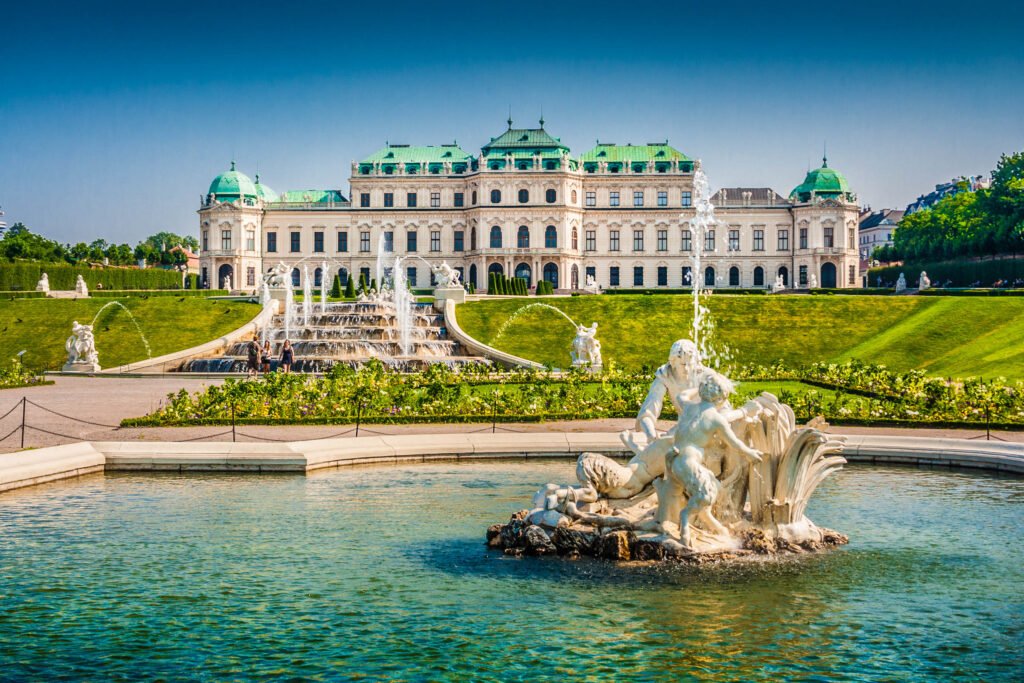
Belvedere Museum
City Hall (Rathaus)
Museum Quarter
House of Secession
Secession Building, one of Vienna’s main attractions. The so-called “Secession” in Vienna was, in other words, an artistic event. Gustave Klimt and his followers decided to break away from the Vienna Classical School of Art and found their own school. Hence the name “secession.” They decided to build a building that would serve as a venue for the expression of their art. As a result, they built the Secession Building.
Inside are Klimt’s famous “Beethoven Friezes,” which are frescoes in honor of Beethoven and his Ninth Symphony.
We can identify various characters in the frescoes, such as the hybrid monster, which is half gorilla, half snake; the Gorgons (disease, madness, and death), who are his daughters; the deadly sins, such as Lust, Intemperance, and Gluttony (with a prominent belly); further to the right, Sadness; on the other wall, Poetry, symbolized by a girl playing the lyre; the choir of angels, and a man embracing and kissing a woman; and on the opposite wall, some commoners kneeling, begging the king.
Brief historical accounts about Austria
In ancient times, that is, in prehistory, Austria was occupied by Celtic tribes. Later, the Roman Empire expanded its borders, taking over the region. Following the fall of the Roman Empire in the 4th century, the region was taken over by barbarians.
On the other hand, in the 8th century, Charlemagne took over the region and introduced Christianity. From the 13th century onwards, the House of Habsburg took power and remained monarchs until World War I.
The rise of nationalism and external defeats between 1848 and 1866 resulted in the reorganization of the monarchy, which gave rise to the Austro-Hungarian Empire, the last period of the Habsburgs (1867-1918). It was a period characterized by permanent political crisis between the various nationalities, but, on the other hand, by great economic, social, and cultural development.
In 1918, after defeat in World War I and the breakup of the Austro-Hungarian Empire, the Republic of German-Austria was created. Austria then became a parliamentary republic, characterized above all by constant economic, political, and social crisis.
Austria was annexed by Nazi Germany in 1938, and after the Allies won World War II, the country regained its full independence. In 1995, Austria finally joined the European Union (source: Wikipedia).