
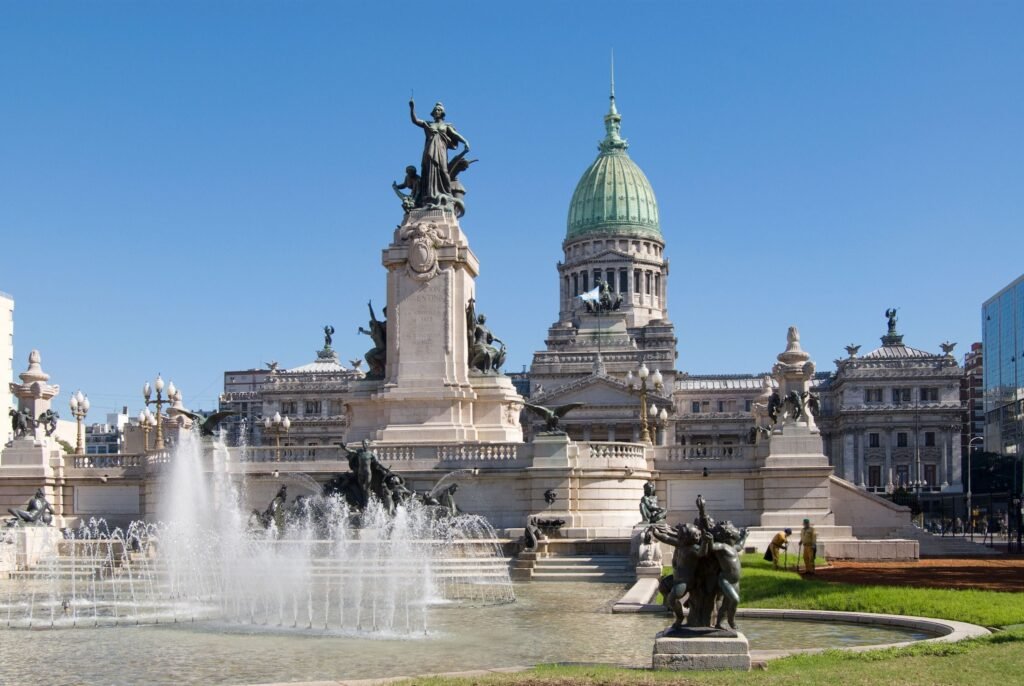
Welcome to Argentina: a destination that offers the best of South America!
Although many travelers choose Buenos Aires as their first international trip, Argentina goes far beyond the capital and offers other destinations that are worth adding to your itinerary.
From world-renowned wineries to desert regions with unique landscapes, passing through cities in the far south, where it is really cold and you can ski and drink hot chocolate with your family.
There is so much to enjoy: tango, wine, delicious food, cold beer, and charming cities, all added to impressive scenery.
Each region has something special to offer, and the advantage is that you don’t have to see everything at once.
Argentina can be explored in stages or by region, depending on how much time you have.
Buenos Aires
Depending on what time you arrive in Buenos Aires, leave the first day free.
With free time, you can visit places of interest at your leisure. To do this, I suggest starting with Avenida 9 de Julio.
Obelisk of Buenos Aires
The Obelisk is the city’s icon, built to commemorate and honor the fourth centenary of the founding of Buenos Aires.
Therefore, the place is always one of the main protest points for Argentinians, and there will always be someone demanding something.
Furthermore, the place is very photogenic, and you’ll pass by it several times since it’s right in the middle of Avenida 9 de Julio.
Right in front of the Obelisk there’s a large sign with the Buenos Aires abbreviation “BA,” which is ideal for taking photos since the Obelisk is in the background.
Casa Rosada
In Plaza de Mayo, the main tourist attraction is the Casa Rosada, the seat of the Argentine government and an emblematic building.
Since it’s entirely pink and occupies a large part of the plaza, and if you take the Free Tour of the city center, you’ll understand why the Argentine government headquarters is that color.
Buenos Aires Metropolitan Cathedral
Also located opposite Plaza de Mayo is the city’s beautiful Metropolitan Cathedral, the main seat of the Catholic Church in Argentina.
It was first built in 1593 and has since undergone at least six constructions before reaching its current form.
The place is more than a church; it’s practically a museum, with many works of art, impressive decoration, and incredible architecture.
It also houses the mausoleum of San Martín, the main general who fought for the independence of Argentina and other South American countries.
And if you’re lucky, you might witness the changing of the guard that takes place between the Casa Rosada and the Metropolitan Cathedral.
Puente de La Mujer
The woman’s bridge is a bridge that represents the image of a couple dancing the tango, hence its unique architecture.
As one of the iconic landmarks of the Puerto Madero neighborhood, this bridge even has a rotating mechanism that allows boats to cross the river.
I’ve been to Buenos Aires several times and never seen it working; perhaps you’ll have better luck.
Also, I suggest going at night to take photos of the illuminated bridge, which looks beautiful against the backdrop of the river and the buildings.
Fragata Sarmiento
Right next to the bridge you’ll see a very large ship anchored there; it’s the Frigate Sarmiento.
The frigate is a large ship from 1897 that at the time was one of the most technologically advanced in the world and is currently a museum that tells the story of the frigate and also of the Argentine Navy.
She is considered one of the most important ships of her time, having made approximately 37 voyages around the world.
It’s worth visiting, as the entrance fee is very cheap and in less than 40 minutes you can see the inside of the frigate and all the information on display.
In addition, it offers a beautiful view of Puerto Madero and the Puente de la Mujer (Women’s Bridge), which provides great photo opportunities.
La Boca
On your second day in Buenos Aires, I suggest going to one of the city’s most traditional neighborhoods, La Boca.
There you can explore the famous Caminito, where you can stroll and discover the shops, restaurants, leather goods stores, and handicrafts.
The process is the same as the tour of the historic center; upon meeting the guide at the meeting point, he will lead a small group through the neighborhood.
He will explain the history of the neighborhood, interesting facts, and how the famous tenement houses came about, and you can also ask him any questions you may have.
The tour goes through Caminito, walking through the streets of the La Boca neighborhood until reaching La Bombonera, the iconic stadium of Boca Juniors.
As I mentioned, the tour is voluntary, based on the experience of the tour.
La Bombonera
Since the tour of the La Boca neighborhood ends at La Bombonera stadium, you can visit the Boca Juniors Museum if you’re a football fan.
The Boca Juniors stadium is a must-see for anyone who enjoys football, so, as I love football, I had to go.
However, due to construction at the stadium, I didn’t end up visiting the museum, as the panoramic tour was what interested me most.
The museum itself is small, with a mini-path inside, a trophy room, and of course, a summary of the team’s history.
After visiting the stadium museum or just taking photos of the front of the stadium, I now recommend returning to Caminito and strolling around without a specific goal.
It’s time for a leisurely stroll down the main street, which is an open-air museum and, in case you didn’t know, one of the most photographed streets in the world.
Go inside the shops, the old tenements that are now stores selling everything and have lots of cool stuff.
Take the opportunity to visit Cachafaz do Caminito, an alfajor shop located in the building that appears in practically every postcard of Caminito.
Go upstairs and ask someone to take a picture of you from outside; it’s really cool.
And don’t forget to buy some alfajores from Cachafaz – they’re delicious!
National Historical Museum of Argentina
In less than 40 minutes you can visit this museum that tells the story of Argentina’s independence.
There you’ll find documents and items from the War of Independence and the famous May Revolution.
Furthermore, you’ll discover important figures who are part of Argentina’s history of struggle against England and Spain.
It’s really cool to learn about the pride in these struggles and the care with which they preserve the history of the country’s independence.
Therefore, it’s worth visiting this museum, which is small and won’t take up much of your time.
Colón Theatre
Founded in 1908, it has a seating capacity of 2478 people and boasts beautiful architecture.
I recommend taking the guided tour to learn about the theater’s history, see one of the boxes, view works of art and paintings, and discover some interesting facts about the place.
If you have the opportunity, it’s worthwhile to see a play or performance at the Teatro Colón; it’s truly a completely different experience.
Barolo Palace
It’s an iconic building, constructed in 1919 and considered the tallest building in Latin America at the time.
But what makes this building special is that it was inspired by Dante Alighieri’s “Divine Comedy.”
The building is full of references, with the floors divided into three parts: Hell, Purgatory, and Heaven.
The best way to experience it is with a guided tour, to see all the references and understand all the details of the building in more depth.
Bariloche
Bariloche is a dream destination for nature lovers, winter sports enthusiasts, and foodies. With breathtaking views around every corner, you can explore its snow-capped mountains, ski or snowboard, ride ATVs on trails, and savor delicious Swiss chocolates in its charming shops.
Surrounded by the peaks of the Andes Mountains, Bariloche boasts crystal-clear lakes, lush forests, and snow-capped mountains, creating a spectacular setting for this scenic tour.
Excursion to San Martín de los Andes
On this tour you will travel through the region of the seven glacial lakes of Patagonia on a route to San Martín de los Andes, a picturesque mountain town on the shores of Lake Lácar.
Excursion to El Bolsón and Lake Puelo
On this excursion, you will discover the beautiful landscapes of Patagonia and visit the town of El Bolsón and Lake Puelo. Prepare to be enchanted!
Horseback riding tour in Patagonia
On this excursion, the guide will pick you up from your hotel in the morning and take you to a rural ranch where you will enjoy a delicious “criollo breakfast” with homemade fried cakes, mate tea, sweets, tea, and coffee. See below the route the horseback riding tour will take.
Sailing trip on Lake Nahuel Huapi
On this tour you will sail through the spectacular landscapes of southern Argentina and fall in love with the incomparable blue of Lake Nahuel Huapi and its numerous islands.
Excursion to Puerto Blest and Los Cántaros Waterfall
On this tour you will take a boat trip on Lake Nahuel Huapi and travel the entire length of Puerto Blest and the Cascata de los Cántaros waterfall.